
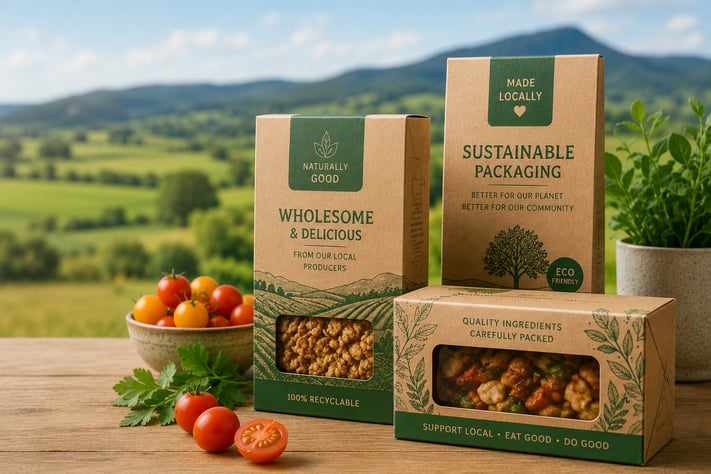
Discover expert strategies for sourcing sustainable packaging suppliers locally, reducing your carbon footprint whilst maintaining quality and cost-effectiveness for your food production business.
Why Sourcing Local Eco-Friendly Packaging Matters for Food Producers
For artisan food producers in 2026, the decision of where to source your printed packaging extends far beyond simple cost considerations. Choosing local eco-friendly packaging suppliers represents a strategic business decision that impacts your environmental credentials, supply chain resilience, and brand authenticity. With consumers increasingly scrutinising the provenance of not just food products but their packaging too, proximity to your packaging partner has become a genuine competitive advantage.
Working with local suppliers dramatically reduces transportation emissions associated with your printed packaging for food producers. Instead of waiting weeks for containers from overseas, regional partnerships mean shorter lead times, reduced minimum order quantities, and the flexibility to respond quickly to seasonal demands or product launches. For small food producers operating on tight margins, this agility can mean the difference between capitalising on market opportunities and missing them entirely.
Beyond environmental benefits, local sourcing enables collaborative relationships that larger, distant suppliers simply cannot provide. Face-to-face consultations allow you to discuss substrate options, printing methods, and food-grade requirements specific to your products. Whether you're packaging artisan preserves requiring heat-resistant materials or delicate baked goods needing protective cushioning, proximity facilitates the kind of bespoke packaging design conversations that elevate your brand from commodity to craft.
Essential Certifications and Standards to Look for in Sustainable Packaging Suppliers
Navigating the certifications landscape for printed packaging can feel overwhelming, but understanding which credentials genuinely matter protects you from greenwashing whilst ensuring compliance. For food producers, the non-negotiable starting point is food-grade certification. Any supplier handling printed packaging for food producers must demonstrate compliance with food contact materials regulations, including migration testing and suitable substrate selection for your specific product category.
Look for suppliers holding FSC (Forest Stewardship Council) or PEFC (Programme for the Endorsement of Forest Certification) chain of custody certification. These credentials verify that carton board substrates originate from responsibly managed forests, providing traceable evidence for your own sustainability claims. In 2026, these certifications have evolved beyond mere badges - they represent audited supply chain transparency that discerning consumers and retailers increasingly demand.
ISO 14001 environmental management certification indicates a supplier's commitment to systematic environmental impact reduction across their operations. For contract packing services, particularly those involving food-grade cleanroom environments, BRC (British Retail Consortium) accreditation provides additional assurance of hygiene standards and operational controls. When evaluating potential partners, request documentation of these certifications and verify their current status through the issuing bodies' databases.
Consider suppliers who can demonstrate carbon footprint measurement and reduction programmes. Progressive packaging specialists now offer carbon-neutral printed packaging options, utilising renewable energy in production and offsetting unavoidable emissions. Ask potential suppliers about their waste diversion rates, water conservation measures, and use of vegetable-based inks - these operational details reveal authentic sustainability commitments beyond marketing claims.
Smart Search Strategies for Finding Green Packaging Partners in Your Region
Begin your search by leveraging industry-specific directories and trade associations. The BCMPA (British Carton and Packaging Manufacturers Association) maintains listings of reputable UK packaging suppliers committed to sustainability standards. Regional manufacturing networks and food producer cooperatives often maintain preferred supplier lists, providing peer-vetted recommendations from businesses facing similar printed packaging challenges.
Don't overlook the power of geographical search strategies combined with specific technical requirements. Rather than generic searches for 'packaging suppliers', refine your queries to 'food-grade digital printing North East' or 'sustainable carton board packaging Newcastle' to identify regional specialists. Many packaging companies maintain strong local presences but limited digital visibility, making telephone conversations with regional business development teams surprisingly productive.
Attend regional food industry trade shows and packaging exhibitions where you can examine substrate samples, discuss print methods, and assess supplier cultural fit in person. Events like Farm Shop & Deli Show or regional food festivals increasingly feature packaging specialists showcasing sustainable materials and contract packing capabilities. These face-to-face interactions reveal supplier responsiveness and technical knowledge that website copy cannot convey.
Consider the complete packaging ecosystem when evaluating suppliers. The ideal partner offers not just printed packaging but complementary services like fulfilment, direct mail capabilities, and flexible order sizes suitable for artisan production volumes. Suppliers who understand the artisan food producer journey - from initial concept to retail-ready packaging - bring invaluable expertise that extends beyond transactional print services.
Evaluating Supplier Credentials Beyond the Green Marketing Claims
In 2026's crowded sustainable packaging marketplace, distinguishing genuine environmental commitment from superficial greenwashing requires rigorous evaluation. Request specific data rather than accepting generalised environmental statements. Ask potential suppliers for their Scope 1, 2, and 3 emissions data, waste diversion percentages, and third-party sustainability audit results. Suppliers confident in their credentials willingly share measurable environmental performance indicators.
Examine the supplier's substrate options and printing processes in detail. Truly sustainable printed packaging for food producers utilises recyclable or compostable materials with clear end-of-life pathways. Question whether printed films can genuinely be recycled in existing UK infrastructure or whether 'biodegradable' claims rely on industrial composting facilities unavailable to most consumers. Your packaging's environmental credentials ultimately rest on these technical realities, not marketing narratives.
Assess the supplier's innovation trajectory by asking about recent material developments and upcoming sustainable solutions. Progressive packaging specialists actively trial emerging substrates like agricultural waste-based boards, algae-based inks, and barrier coatings that maintain recyclability. Their willingness to discuss both current capabilities and acknowledged limitations signals intellectual honesty more valuable than unrealistic promises.
Request customer references from similar-sized food producers and follow up with candid conversations. Ask these references about order accuracy, communication responsiveness, problem-solving during production challenges, and whether minimum order quantities genuinely suit small-batch production. The supplier's track record with artisan food businesses reveals operational compatibility that technical specifications alone cannot predict.
Building Long-Term Relationships with Sustainable Packaging Specialists
The most successful artisan food producers view their packaging supplier as a strategic partner rather than a transactional vendor. Cultivating this relationship begins with transparent communication about your business trajectory, seasonal volume fluctuations, and evolving sustainability goals. Suppliers equipped with advance visibility into your needs can secure substrate inventory, schedule production capacity, and propose innovations aligned with your product development roadmap.
Establish regular review cadences beyond order placement conversations. Quarterly business reviews provide opportunities to evaluate packaging performance, discuss emerging sustainability standards, and explore new printed packaging options as your production volumes grow. These structured touchpoints build institutional knowledge about your brand requirements, reducing errors and enabling increasingly tailored solutions.
Collaborate on packaging design evolution rather than viewing it as solely your responsibility. Experienced packaging specialists understand how substrate selection, printing methods, and structural design intersect to create both visual impact and functional performance. Their technical expertise can optimise your packaging for both sustainability credentials and production efficiency—often identifying cost savings that fund premium sustainable materials elsewhere.
Consider consolidating services with suppliers offering complementary capabilities. A packaging partner providing contract packing services, printed packaging, and direct mail fulfilment simplifies your supply chain whilst deepening the commercial relationship that incentivises their investment in your success. This integrated approach proves particularly valuable for artisan producers lacking dedicated logistics resources, transforming your packaging supplier into an extension of your operational team.
Finally, recognise that building sustainable relationships mirrors building sustainable packaging—both require long-term thinking over short-term optimization. Suppliers who weather your business's inevitable fluctuations, accommodate urgent order modifications, and invest in understanding your products earn loyalty that transcends marginal price differences. In 2026's complex packaging landscape, this relational capital represents a competitive advantage as valuable as any substrate innovation.
